
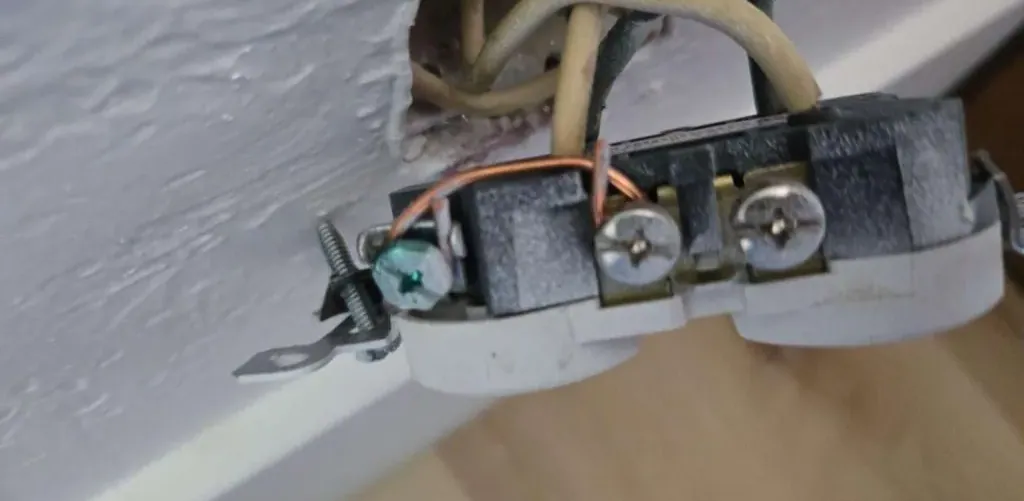
If you own an older Sacramento home, you might think your three-prong outlets mean you are safely grounded. But there is a dangerous shortcut called a "bootleg ground" that could be putting your family at risk, and most homeowners have no idea it's there.
At Peach Electric, we encounter bootleg grounds regularly during inspections and service calls throughout the Sacramento area. These fake grounds are one of the most deceptive and dangerous violations we find, often installed by unqualified handymen, house flippers, or well-meaning DIYers who did not understand the hazard they were creating.
What Is a Bootleg Ground?
A bootleg ground, also called a false ground, is an improper connection where the neutral wire (white) is connected to the ground terminal (green screw) of a three-prong outlet. This creates the illusion of a properly grounded outlet when in reality there is no real ground connection at all.
In older Sacramento homes built before the 1960s, most electrical systems used two-wire circuits: one hot wire and one neutral wire, with no separate ground wire for safety. When these homes are updated, the proper solution is to either run new three-wire cable with a ground, or install GFCI protection with appropriate labeling.
Instead, some people take a dangerous shortcut. They install modern three-prong outlets and connect a small jumper wire between the neutral screw and the ground screw. To a basic outlet tester, this looks correct, but it's actually creating a serious safety hazard. People do it to save time and money, because running new wire is expensive and a bootleg ground takes seconds to install and will fool the basic three-light testers many home inspectors use.
The Deadly Difference Between Neutral and Ground
To understand why bootleg grounds are so dangerous, you need to understand the difference between the neutral wire and the ground wire.
The neutral wire (white) is a current-carrying conductor. During normal operation, electricity flows from your panel through the hot wire to your device, then returns through the neutral back to the panel. The neutral carries current constantly when devices are running.
The ground wire (bare copper or green) is not supposed to carry any current during normal operation. It's your emergency backup. The ground wire only carries current when something goes wrong, such as when insulation fails or a hot wire touches a metal appliance case. When that happens, it provides a direct path for the dangerous electricity to flow safely back to the panel, tripping the breaker before someone gets hurt.
The critical point: the ground and neutral are only connected together at one location, the main service panel. Bonding them together anywhere else is a code violation that creates multiple dangerous conditions. When you install a bootleg ground, normal current now flows through what should be your safety ground system.
Why Bootleg Grounds Are Extremely Dangerous
The Open Neutral Hazard
The most dangerous scenario happens when the neutral wire becomes loose or disconnected somewhere upstream, a condition called an open neutral. When this occurs with a bootleg ground installed, electricity can no longer return through the normal neutral path, so it finds a new path through the bootleg jumper, through the ground wire, and through any connected metal parts, including:
- The metal casing of your refrigerator, washer, dryer, or dishwasher
- Metal electrical boxes and cover plates
- Metal light fixtures
- Metal plumbing pipes connected to the electrical system
- The metal frame of power tools
All of these surfaces can become energized with 120 volts. Anyone who touches them can receive a serious, potentially fatal shock. Unlike a properly grounded system where a fault trips the breaker, the circuit may continue to appear functional while metal surfaces throughout your home sit electrified.
Reverse Polarity Makes It Worse
When a bootleg ground is combined with reverse polarity, where hot and neutral are swapped, every metal appliance case, box, and switch plate connected to the ground system becomes energized the moment you plug something in, with no fault required. Basic three-light testers won't detect this combination.
GFCI Protection May Not Work
A bootleg ground creates an intentional connection between neutral and ground at the outlet, which can prevent a GFCI from properly detecting ground faults. In some configurations, leakage current returns through the bootleg path instead of the neutral, and the GFCI never sees the imbalance that should trip it. You may have paid for safety equipment that has been sabotaged by improper wiring.
Fire Hazards from Overheated Connections
Ground wires and connections are sized to handle high fault current briefly before the breaker trips, not to carry continuous operating current. When bootleg grounds force operating current through ground paths, receptacle mounting screws can overheat, ground connections can develop high resistance, and current can divide among unexpected paths, creating hot spots that can ignite surrounding materials.
Equipment Damage
Modern electronics rely on a proper ground reference for voltage stability, surge protection, and proper operation. Plugged into outlets with bootleg grounds, devices may experience erratic behavior, premature failure, corrupted data, reduced lifespan, and voided warranties.
The Other Fake Ground: Ungrounded Metal Boxes
There is another deceptive practice we encounter: grounding an outlet to a metal box that is not itself grounded. Someone finds a metal box with old two-wire cable, installs a three-prong outlet, and attaches the ground screw to the box. The problem is that the box has no connection to the home's grounding system. It's just metal sitting in the wall, electrically isolated. For a metal box to serve as a ground, it must be connected to the grounding system via a ground wire run with the circuit conductors, or be part of a properly installed and bonded metal conduit system. Simply being made of metal doesn't make a box grounded.
How Bootleg Grounds Fool Inspections
The basic three-light outlet testers that cost a few dollars at the hardware store will show a bootleg ground outlet as correctly wired. That's exactly why people install them. Professionals use different methods:
- Advanced circuit analyzers measure the resistance between neutral and ground. In a properly wired system there is some resistance because the wires run separately back to the panel. With a bootleg ground, the resistance is nearly zero, and these testers display a warning.
- Physical inspection is the most reliable method. Remove the cover plate and a bootleg ground is immediately visible as a jumper connecting the neutral terminal to the ground terminal.
When we inspect older Sacramento homes, especially those built before 1965 or recently flipped, we go beyond basic testing and physically verify the wiring.
The Right Way to Update Ungrounded Outlets
If your home has old two-wire circuits without ground wires, you have several code-compliant options, and none of them involve bootleg grounds.
Option 1: Run New Three-Wire Cable (Most Reliable)
Run new cable that includes a ground wire from the panel to each outlet. This provides full grounding protection and allows standard three-prong outlets throughout. It is the most labor-intensive and expensive option and may require opening walls, so it is best done during remodels. It adds value to your home and meets all current code.
Option 2: Install GFCI Protection (Most Common Solution)
Code allows GFCI-protected outlets on ungrounded circuits, which is often the most practical solution for older homes. Install a GFCI outlet at the first outlet in the circuit to protect everything downstream, or install a GFCI breaker at the panel. All protected outlets must be labeled "GFCI Protected" and "No Equipment Ground." This provides excellent shock protection at much lower cost, though it doesn't provide equipment grounding.
Option 3: Keep Two-Prong Outlets
Keeping or installing new two-prong outlets is simple, inexpensive, and honest about the protection available. The trade-off is inconvenience for modern three-prong devices.
Option 4: Run a Separate Ground Wire
In some cases code allows running a separate equipment grounding conductor back to the panel, installed in raceway for protection. This is a good option when the panel is easily accessible and conduit can be run along a visible path, such as in basements or garages.
How Peach Electric Handles Ungrounded Circuits
When homeowners call us about ungrounded outlets, here's what we do:
- Physical examination of every outlet and circuit tracing back to the panel
- Safety assessment, starting with bathrooms, kitchens, and outdoor areas
- Clear recommendations with pros, cons, and pricing for each option
- Code-compliant installation with testing and documentation
- Permit coordination with the local building department
We don't take shortcuts and we never install bootleg grounds.
Red Flags Your Home May Have Bootleg Grounds
- Your home was built before 1965 and has three-prong outlets without upgraded wiring
- Your home was recently flipped or renovated by unlicensed contractors
- You have three-prong outlets but no GFCI or ground labels in a home you know has old wiring
- You have experienced unexplained electronics failures
- Basic outlet testers show correct wiring but you suspect original two-wire wiring
- Previous electrical work was done without permits
Protect Your Home Today
Bootleg grounds hide behind the appearance of safety while putting your family at risk of shock, fire, and equipment damage. If your home was built before modern grounding standards, has been flipped, or has three-prong outlets you aren't certain about, don't wait for a problem to occur.
Have questions about your home's outlets or grounding? Reach out to Peach Electric for a free, upfront estimate on an electrical safety inspection.